Round
Round
 Radiant
 Emerald
 Oval
Oval
 Pear
Pear
 Cushion
 Princess
 Heart
Heart
 Asscher
 Alphabet
 Trillion
 Half Moon
 Baguette
 Dutch Marquise
 Trapezoid
 Portuguese
 Blue
Blue
 Red
Red
 Pink
Pink
 Grey
Grey
 Champagne
 Yellow
 Green
Green
 Orange
 Brown
Brown
 Black
Black
 Solitaire
 Halo
Halo
 Hidden Halo
 Unique
 Diamond Band
 Bezel
Bezel
 Cluster
 Three Stone
 Dainty
 Vintage
 Wedding Bands
 Eternity Bands
 Anniversary Bands
 Pavé Diamond Bands
 Matching Bridal Sets
 Curved bands
 Five Stone Bands
 Seven Stone Bands
 Nine Stone Bands
 Stackable Bands
 Custom bands
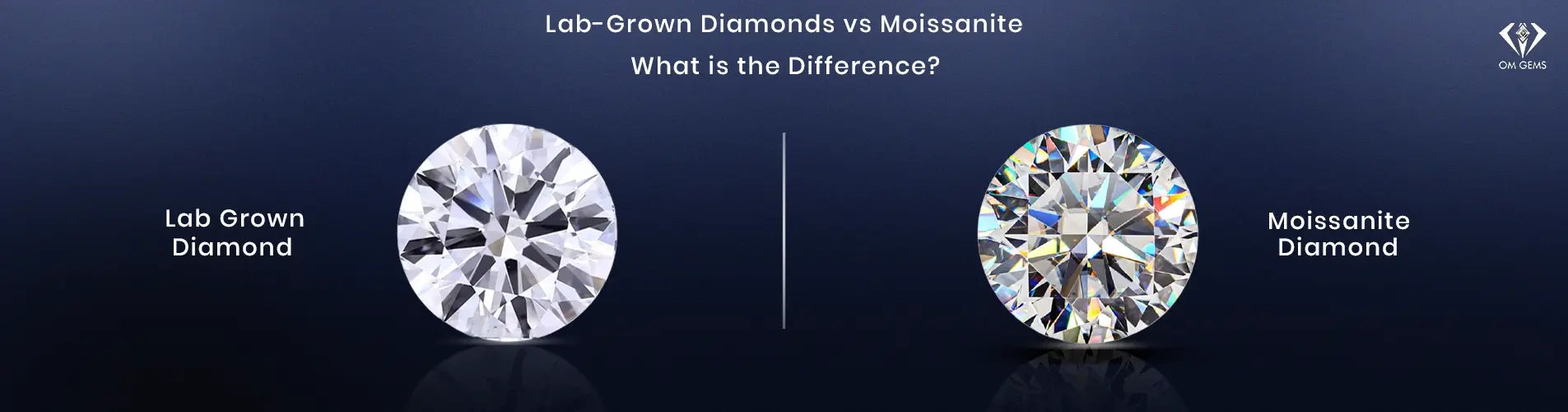
Lab-Grown Diamonds vs Moissanite: What is the Difference?
Lab-grown diamonds and moissanite serve as popular alternatives to natural diamonds because they provide distinct advantages that differ in their visual appeal, pricing, and performance capabilities. The two items appear alike, but they contain critical features that will affect your purchasing choices. The comparison guide will present basic information about their brightness and cost, their strength and total worth assessment. Understanding these differences enables you to choose engagement rings and fine jewelry with confidence, which matches your personal style and financial plan and your future expectations.
What Is Lab Grown Diamond And Moissanite?
Lab Grown Diamond
A lab diamond is a real one diamond, made in a laboratory using advanced technology, and it kind of mirrors how natural diamonds grow. It still has the same chemical makeup, physical traits, and that bright brilliance you expect from a mined diamond, yet it’s usually more affordable and can feel more eco friendly too. People often pick lab-grown diamonds for fine jewelry and engagement rings, not just for the look but also for the toughness, and for the idea of responsible sourcing. Read our ultimate guide to lab-grown diamonds to understand their benefits, quality, and value.
Moissanite
Moissanite is a gemstone formed from silicon carbide, and it’s mostly made in lab conditions for jewelry use. It looks diamond-like, but it’s actually a different kind of gemstone, with its own way of shining, exceptional sparkle, and those colorful little flashes. Moissanite tends to be very durable, it usually costs less than diamonds, and it has become a well liked option for engagement rings and other statement jewelry
Lab-Grown Diamonds vs Moissanite – Key Differences
1. Sparkle & Appearance Comparison
Lab Grown Diamond
The evaluation of sparkle and visual appeal of lab-grown diamonds shows their ability to produce traditional diamond-like brightness, which closely resembles natural diamond appearance. Timeless and sophisticated characterizes their light reflection which creates white sparkle that achieves a clean appearance. The design appeals to consumers who want a delicate shine that avoids extreme brightness. The diamonds display balanced sparkle components that create both authentic and luxurious visual effects that remain constant throughout different lighting scenarios.
Moissanite
Moissanite exhibits two main characteristics which include its high levels of fire and its ability to produce multicolored light patterns that create rainbow-like effects when exposed to light. Diamonds display a more powerful visual effect because of their superior ability to produce bright light which creates more intense sparkling effects. Some people love this extra brilliance while others believe it appears more natural or artificial depending on their individual preferences.
2. Durability & Hardness Comparison
Lab Grown Diamond
Lab-grown diamonds achieve maximum hardness with a Mohs scale ranking of 10 which establishes them as the most durable material used in jewelry for both natural and synthetic creations. The exceptional hardness of these materials provides them with excellent protection against scratches and chips plus standard wear which makes them suitable for use in engagement rings and other jewelry meant to be worn forever. Their durable nature enables them to sustain their shininess and brilliance throughout many years of constant usage.
Moissanite
Moissanite achieves a Mohs rating of 9.25 which makes it the second hardest gemstone after diamonds for use in jewelry. The material possesses lower hardness than diamonds however it maintains excellent strength against scratches and damage from regular use. The material functions as a dependable option which people can wear for their engagement rings and other jewelry pieces they use on a daily basis.
The combination of lab-grown diamonds and moissanite provides two excellent choices for daily wear because both materials deliver permanent strength and attractive appearance which needs very little care.
3. Price Comparison
Lab Grown Diamonds
Lab diamonds have higher prices because their chemical properties match those of natural diamonds and experts use precise diamond evaluation methods to assess their cut, carat clarity, and color. The higher price of moissanite matches its diamond value and luxury appeal which makes it a preferred choice for customers buying engagement rings and high-end jewelry.
Moissanite
Moissanite serves as an economical alternative to lab-grown diamonds which makes it a preferred choice among customers who need to stick to tight budgets. The material maintains its low-cost pricing for all stone sizes because its production process uses silicon carbide which scientists developed in lab conditions. The customer can obtain a larger diamond that attracts attention while saving money because both diamonds display outstanding brilliance and durability.
4. Value & Resale Comparison
Lab Grown Diamond
Lab-grown diamonds maintain better value because they possess identical chemical properties to natural diamonds, while their value assessment uses the same grading system as natural diamonds. The diamonds possess greater value because their chemical match to natural diamonds extends their certification process with natural diamond grading systems. The jewels actually develop better customer value because consumers link their value to their authentic and luxurious quality. The diamonds maintain their value better than other options because customers see them as superior products, even with their reduced value growth.
Moissanite
Moissanite has a much lower resale demand because it is considered a diamond alternative rather than a true diamond. Moissanite provides outstanding brilliance and durability; however, its market value depends on its low price and visual appearance instead of its uncommon characteristics and grading standards. The market for resale products typically results in minimal resale value.
Buying Intent Explanation
Both products fail to provide suitable options for investment purposes because they have different functions. The superior choice between lab-grown diamonds and moissanite depends on buyer preferences because lab-grown diamonds provide better luxury value, while moissanite allows customers to save money while enjoying its visual qualities.
5. Which Should You Go With?
Select Lab-Grown Diamonds If:
-
If you desire the diamond experience, the real deal from Lab Grown is the best fit since it is physically and chemically identical to mined diamonds.
-
Lab grown stones are particularly fitting for engagement rings, gifts to be treasured for the long haul.
-
They can also be favored by consumers for perceived value, grading, and lasting appeal. If you're seeking traditional luxury and value, lab grown is the way to go.
Select Moissanite If:
-
The right choice if you're budget-conscious but still want something flashy, the shimmer of a moissanite will certainly draw attention.
-
Moissanite will be ideal if you are looking for the most sparkle because it has greater dispersion, more fire and is the best choice when you need a flashier and larger sparkle for fashion pieces and affordable baubles.
Before making your final choice, learn how to choose the right engagement ring guide.
Conclusion
Both lab-grown diamonds and moissanite make great modern alternatives to natural diamonds, but they cater to very different preferences and situations. If you want a real diamond with premium quality and a look that will be chic forever, and one with that added value perception which makes it truly ideal for special pieces such as engagement rings, then a lab-grown diamond is the best option for you. Explore our complete collection of Lab Diamond Engagement Rings featuring timeless and modern designs for every style.
However, if you want something stunning with unparalleled brilliance and a fire and life you just can’t get otherwise, and you’re happy to save the money and skip on the authenticity factor of a natural stone, then moissanite is the ideal gem. Ultimately, the right choice will depend entirely on what you want, but it will either be an authentic high-end lab diamond or a sparkly lower-cost alternative.
FAQs
1. Is moissanite a real diamond?
No, moissanite is not a diamond. It is a separate gemstone made of silicon carbide, although it looks similar to a diamond.
2. Are lab-grown diamonds real diamonds?
Yes, lab-grown diamonds are real diamonds. They have the same physical, chemical, and optical properties as natural diamonds.3. Which sparkles more, moissanite or lab-grown diamond?
Moissanite typically sparkles more with rainbow-like flashes, while lab-grown diamonds have a classic white sparkle.4. Can people tell the difference between moissanite and lab diamonds?
To the untrained eye, they can look similar, but experts can identify differences in sparkle and composition.
5. Is moissanite durable enough for daily wear?
Yes, moissanite is very durable with a hardness of 9.25, making it suitable for everyday jewelry.
6. Do lab-grown diamonds last forever?
Yes, lab-grown diamonds are extremely durable and can last a lifetime, just like natural diamonds.
7. Which is more affordable, moissanite or lab-grown diamonds?
Moissanite is significantly more affordable than lab-grown diamonds.
8. Is moissanite a good choice for engagement rings?
Yes, moissanite is a popular choice for engagement rings, especially for those seeking a budget-friendly yet sparkling option.